


Fill-in Word: Crossword Puzzle
4.96.00 Reviews
App Specs
- Version
- 6.2.3
- Updated On
- License
- Free
- Downloads
- 10,000+
- Developer
- CASUAL AZUR GAMES
- Categories
- Word
- Platform
- Android
Screenshots
 Analysis by AppCompare
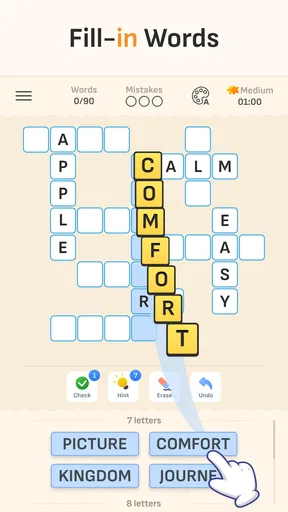
I approached Fill-in Word: Crossword Puzzle as a quick word-game option rather than a traditional newspaper-style crossword replacement. Its basic idea is easy to understand: complete a fill-in word puzzle by using the letters and crossings to work out what belongs in each space. That simplicity makes it approachable, but the real appeal comes from how it turns short bursts of concentration into a repeatable habit.
In my experience, this is the kind of game that fits naturally into small gaps in the day. I can imagine opening it while waiting for an appointment, taking a short break from work, or settling down with something lighter than a full strategy game. It is free to download, although optional purchases range from $0.99 to $19.99 per item, so I would treat it as a free starting point and pay attention to any purchase prompts during longer sessions.
How the current version feels to play
The current release is version 6.2.3, and that matters because a word puzzle lives or dies by the quality of its everyday handling. The central loop needs to feel clear enough that I can focus on vocabulary and deduction instead of fighting the interface. Fill-in Word: Crossword Puzzle presents itself as a compact brain and logic game, and that description matches the experience better than calling it a broad crossword suite.
The fill-in format changes the mood compared with clue-heavy crosswords. Instead of relying entirely on general knowledge or obscure definitions, I can use the pattern created by crossing letters. That makes the game more forgiving when one word is unfamiliar. A partly completed row can reveal the first letter of another answer, and that answer can then unlock a third. The pleasure comes from gradually reducing uncertainty rather than solving every clue in isolation.
That structure also creates a useful rhythm for different skill levels. A beginner can start with the most obvious entries and let the board provide assistance through intersections. A more experienced player can scan for unusual letter combinations, short words, and likely endings before filling everything in. I find that this gives the game more depth than its simple presentation initially suggests.
A practical way to approach each puzzle
My preferred method is to avoid forcing the first difficult space I see. I begin with the entries that look most certain, then use their letters as anchors. After that, I check the words crossing those anchors and look for places where only one arrangement makes sense. This is more efficient than tapping random possibilities, and it keeps the puzzle feeling like a reasoning exercise instead of a guessing contest.
One useful habit is to pause after filling a promising section rather than immediately chasing the next isolated word. A completed corner often supplies enough information to make a previously vague area obvious. This is a small but important distinction: the strongest progress usually comes from building reliable letter patterns, not from trying to solve the board in a straight line from top to bottom.
Worth Reading Before You Choose

Flipboard Shows What News Apps Must Do Beyond the Feed

Switching to Android Auto Means Rethinking Your Driving Routine

Google Calendar Makes a Crowded Week Easier to Manage

Ludo King Makes the Most of the Minutes Between Plans

Baby Panda World Brings Quick Play to Modern Phones, but Its Game Library Feels Busy

ESPN’s Live Game View Makes Following Close Games Easier
I also recommend treating mistakes as information. If a crossing produces an impossible-looking combination, I would revisit the least certain word first instead of assuming the whole section is wrong. That approach is especially helpful in a fill-in game because one uncertain answer can distort several nearby spaces.
Why the format works for short sessions
The game’s word-and-logic focus makes it suitable for players who want something mentally active without committing to a long campaign. I can play for a few minutes, stop, and return later without needing to remember a complicated story or a large collection of controls. That makes it more convenient than many puzzle games that require sustained attention before a level feels complete.
A realistic everyday use would be a short evening break after work. I might complete the easy entries first, leave one stubborn section unfinished, and return to it after doing something else. The change of context can help because the answer is sometimes easier to see after I stop staring at the same letters. In that sense, the game can work as a gentle concentration exercise rather than merely a way to pass time.
It is also a reasonable choice for someone who enjoys word games but finds standard crosswords intimidating. The crossings offer a safety net, while the logic element rewards careful observation. Players who prefer a completely open-ended crossword experience may find the fill-in approach less demanding, but that is also what makes it less stressful.
What the release details suggest about its development
CASUAL AZUR GAMES is the developer behind the title. The listed release date is July 10, 2026, while the current version is already 6.2.3. I would read that combination as a sign that the product has moved beyond a first public build and has gone through several rounds of iteration. It does not prove that every rough edge has been removed, but it does make the current version more relevant than an early launch snapshot.
For existing players, the most meaningful question is not simply whether the version number has changed. It is whether the game now feels dependable during the small interactions that happen repeatedly: selecting a space, entering a letter, correcting an answer, and understanding what the board expects next. Those details determine whether a word puzzle remains relaxing or becomes unnecessarily fiddly.
The available audience is still relatively focused. The game has passed 10K installs and carries a 4.9 average from 59 ratings, with 4 written reviews. That combination suggests a very positive early response, but I would not treat it as the same kind of broad consensus found in a huge, long-established puzzle platform. The rating is encouraging; the smaller pool means my own preferences would still matter a great deal.
The Teen content rating is another practical point for families and younger players. I would not assume that the label means the game is unsuitable for every younger user, but parents should check the store page and the device’s purchase controls before handing it over. The presence of optional purchases makes that preparation worthwhile, especially on a shared phone or tablet.
What version 6.2.3 means for someone installing today
If I were installing the game now, I would choose the current version rather than judge it by older comments or early impressions. Version 6.2.3 is the build a new player is most likely to encounter, and it is the one that should shape expectations about stability and usability. At the same time, I would keep my expectations measured: a higher version number can reflect maintenance and refinements without guaranteeing a major transformation of the puzzle system.
The minimum operating-system requirement is Android 7.0 or later. That is useful to know before downloading, particularly if the game is intended for an older spare device. On a compatible phone, the real test is whether the presentation feels comfortable on the screen size available. Word puzzles benefit from readable letters and accurate taps, so a very small display may make the experience less pleasant even when the software technically runs.
Because the game is free, the installation decision is relatively low-risk. I can try the basic loop without paying first, then decide whether its pace and puzzle style justify any optional spending. That is a better approach than buying immediately, since the core question is personal: do I enjoy this particular fill-in format enough to return to it?
How current users may notice the evolution
Players who started with an earlier build may notice the difference most in consistency rather than in a single dramatic feature. A mature puzzle app should make repeated actions feel predictable. If the current release has improved that flow, returning users will benefit every time they correct a letter or move between connected entries, even if the board itself looks familiar.
There is also a psychological effect to regular version updates. They can make a simple game feel maintained rather than abandoned, which matters for a title built around repeat visits. Still, I would judge the update history by the current playing experience, not by the version label alone. A word game needs fresh reasons to return, clear progression, and a comfortable solving process; technical iteration is valuable, but it is only one part of long-term appeal.
Where it stands beside familiar alternatives
Compared with a classic clue-based crossword, Fill-in Word: Crossword Puzzle is easier to enter because the player can lean on crossing letters more heavily. Traditional crosswords often reward broad knowledge, cultural references, and precise interpretation of clues. This game places more emphasis on recognizing patterns and making deductions from the board. I would recommend it to someone who likes wordplay but does not want every session to feel like an examination.
Compared with a daily five-letter guessing game, it offers a wider board and a more connected solving process. A short guessing game gives immediate feedback and a very contained challenge. Here, the satisfaction comes from watching several words support one another. The trade-off is that a fill-in puzzle can require more sustained attention, especially when one unresolved area blocks progress.
It also differs from anagram games. Anagrams usually make letter manipulation the main challenge, while this format asks me to think spatially as well. I need to consider how a possible word affects its neighbors. That extra layer makes it more rewarding for players who enjoy deduction, but less attractive to anyone seeking a rapid stream of tiny rounds.
For a person who wants vocabulary learning, a dictionary-centered word app may be a better choice. Fill-in Word: Crossword Puzzle is primarily about solving, not studying definitions in depth. Likewise, people who expect a rich story, competitive multiplayer, or a large strategic system should look elsewhere. This game’s strength is its focused puzzle loop, and its limitation is the same focus.
Who should try it, and who should skip it
I think it is a good fit for casual word-game fans, crossword newcomers, and players who enjoy quiet logic challenges. It is especially suitable for someone who likes to solve at their own pace and appreciates the moment when several crossings suddenly make sense. The free entry point also makes it easy to test without committing to a purchase.
I would be more cautious about recommending it to players who need constant novelty or a strong sense of progression. If you prefer action, competition, elaborate rewards, or puzzles that change rules from one round to the next, the focused fill-in structure may feel repetitive. It may also frustrate people who dislike being stuck on a board and would rather receive immediate, highly explicit feedback after every attempt.
Another trade-off concerns language confidence. Players with a smaller English vocabulary may find some entries slower to recognize, even when the crossings are helpful. The game can still be approachable, but the experience will depend on how comfortable the player is with English word patterns. That is different from a purely visual logic game, where vocabulary is not part of the barrier.
Remaining friction and sensible expectations
The biggest limitation is inherent to the format: once I understand the solving rhythm, the experience depends heavily on the quality and variety of the puzzles available. A clean interface cannot compensate forever if the boards begin to feel too similar. I would therefore evaluate the game over several sessions, not just one enjoyable first attempt.
The purchase range also deserves a little caution. Free-to-play word games can be perfectly enjoyable without spending, but optional items may become more tempting when a difficult board interrupts momentum. My advice is to decide in advance whether I am willing to pay for convenience, and to use device-level purchase restrictions if children or other family members share the device. The game is free, but “free” does not mean every part of the surrounding experience is cost-free.
The Teen rating should be treated as a practical signal rather than ignored. Anyone choosing the game for a younger player should review the store controls and supervise purchases appropriately. I would also consider the screen itself: extended close-up reading can be tiring, so short sessions and a comfortable display are preferable to treating the game as an all-day activity.
Another point is that the game is not the best tool for every kind of mental exercise. It encourages pattern recognition, spelling awareness, and flexible deduction, but it is not a substitute for a vocabulary course or a full crossword reference. I enjoy it most when I want a compact challenge, not when I am trying to systematically learn new words.
What I would watch in future updates
For future development, I would pay attention to whether the puzzle experience continues to feel varied and whether returning players have enough reason to open the game again. A successful update would ideally preserve the straightforward fill-in loop while improving the small points that affect daily use: clarity, pacing, correction handling, and the overall sense that each session offers a worthwhile challenge.
I would also watch how the game balances optional purchases with the free experience. The strongest version of this kind of app lets casual players enjoy the core activity without feeling pushed, while giving committed users meaningful ways to support or extend their play. That balance is more important to me than adding complexity for its own sake.
The current rating is promising, but future ratings and written feedback will show whether that early enthusiasm holds as the audience grows. A larger player base can reveal edge cases that a smaller group does not, particularly around puzzle difficulty and long-term variety. I would treat that future feedback as useful context rather than assume the present score tells the entire story.
My recommendation after spending time with it
Fill-in Word: Crossword Puzzle succeeds because it keeps the central idea focused. It gives me a word challenge that relies on crossings and deduction, without demanding the broad knowledge or time commitment associated with a traditional crossword. The result is approachable enough for beginners but still satisfying when I use a careful solving method instead of guessing.
My strongest recommendation is to try it during short, quiet sessions and judge whether the fill-in format suits you. Start with certain entries, build dependable letter anchors, and return to stubborn sections after a break. That workflow makes the game feel more thoughtful and reduces the frustration of repeatedly attacking the same unknown space.
I would not choose it for competitive play, deep language study, or elaborate progression. I would choose it for a free, compact word-and-logic experience that can occupy a few spare minutes and reward patient observation. CASUAL AZUR GAMES has a focused product here, and version 6.2.3 is a sensible point from which to evaluate it. If you enjoy the moment when one crossing unlocks an entire corner of a puzzle, this is worth trying; if you need constant novelty, a different word-game format will probably suit you better.
Pros
- Offline play lets you solve puzzles without an internet connection.
- Clean interface makes clues and letter entry easy to follow.
- Hints help unblock difficult answers without revealing the whole puzzle.
- Short levels are convenient for quick breaks or daily play.
- Word variety helps exercise spelling and vocabulary skills.
Cons
- Some puzzles may feel repetitive after extended play sessions.
- Hints or extra content may be limited unless you watch ads or pay.
- Difficulty can vary noticeably between consecutive puzzles.
- Small text or tiles may be uncomfortable on compact phone screens.
- A mistake can be frustrating when several answers share similar meanings.
FAQs for Fill-in Word: Crossword Puzzle
What is Fill-in Word: Crossword Puzzle?
Fill-in Word: Crossword Puzzle is a word puzzle game built around completing crossword-style grids with the correct words. Instead of relying only on traditional clues, the game generally focuses on placing available words into matching spaces, making it approachable for players who enjoy vocabulary challenges without wanting an extremely difficult starting experience. It is suitable for short sessions or longer relaxing play.
How does the gameplay work?
The main objective is to examine the puzzle grid, identify the word lengths and crossing letters, and place the available answers in their correct positions. Each completed word helps reveal additional letters, making the remaining entries easier to solve. The difficulty can increase gradually, so beginners can learn the mechanics while experienced word-game players still have plenty of opportunities to test their vocabulary and deduction skills.
Can I play Fill-in Word: Crossword Puzzle offline?
Many puzzle games of this type allow the core levels to be played without a constant internet connection, which is convenient for travel, commuting, or playing in areas with weak reception. However, some features may still require internet access, including advertisements, cloud synchronization, updates, leaderboards, or optional purchases. It is best to launch the game online at least once and check which features remain available after disconnecting.
Is Fill-in Word: Crossword Puzzle free to download and play?
The game can generally be downloaded without an upfront payment, but free access may be supported by advertisements or optional in-app purchases. Depending on the version, purchases may remove ads, provide hints, or unlock additional content. Before downloading, review the store listing and payment settings carefully, especially if children will use the device, because optional items can affect the overall cost of playing.
Is Fill-in Word: Crossword Puzzle suitable for beginners and children?
The straightforward fill-in format makes the game accessible to beginners, particularly players who enjoy word searches, crosswords, and casual brain-training activities. Younger players may also benefit from practicing spelling and vocabulary, although the suitability depends on the language, word difficulty, advertisements, and any external links included in the app. Parents should review the age rating and consider enabling purchase restrictions before handing over the device.


